
The meeting
In classical mechanics or classical electromagnetism courses, we help students build physical intuition: a clear picture of the processes the equations describe. In quantum mechanics, teaching centers on the mathematical formalism, and that gap matters more as calculation becomes increasingly automated.
Quantum mechanics predicts experiments with extraordinary precision, yet physicists still disagree about what it tells us about the world. Several accounts give the same predictions and very different pictures; most courses teach one, often only implicitly. This meeting brings together physics education researchers, philosophers and physicists working on the foundations of quantum mechanics to explore what students gain from bringing questions about the physical meaning of the mathematical formalism into the standard course, rather than leaving them aside.
1927 · 2027
A century after Solvay
In October 1927 the fifth Solvay Conference in Brussels set rival accounts of the new quantum theory side by side. Louis de Broglie, who had introduced matter waves in his Paris thesis, presented his pilot-wave theory; Born and Heisenberg presented quantum mechanics; Schrödinger, wave mechanics. The debate did not end there.
- 1924ParisDe Broglie's thesis on matter waves
- 1927BrusselsRival accounts debated at Solvay
- 2027ParisWhat should students learn from them?
A hundred years on, the debate is still open. This meeting returns to Paris to ask what it means for teaching.
Provisional program
The detailed program and speakers are being developed.
- Wednesday
- Main views and what they offer quantum educationInvited speakers present the main views and discuss what each may help students understand.
- Thursday
- Evidence and resources for teachingEducation research, historical cases, simulations, and course materials inform round tables on classroom approaches.
- Friday
- Guidance for instructorsRound tables and working groups draft practical teaching options and open research questions.
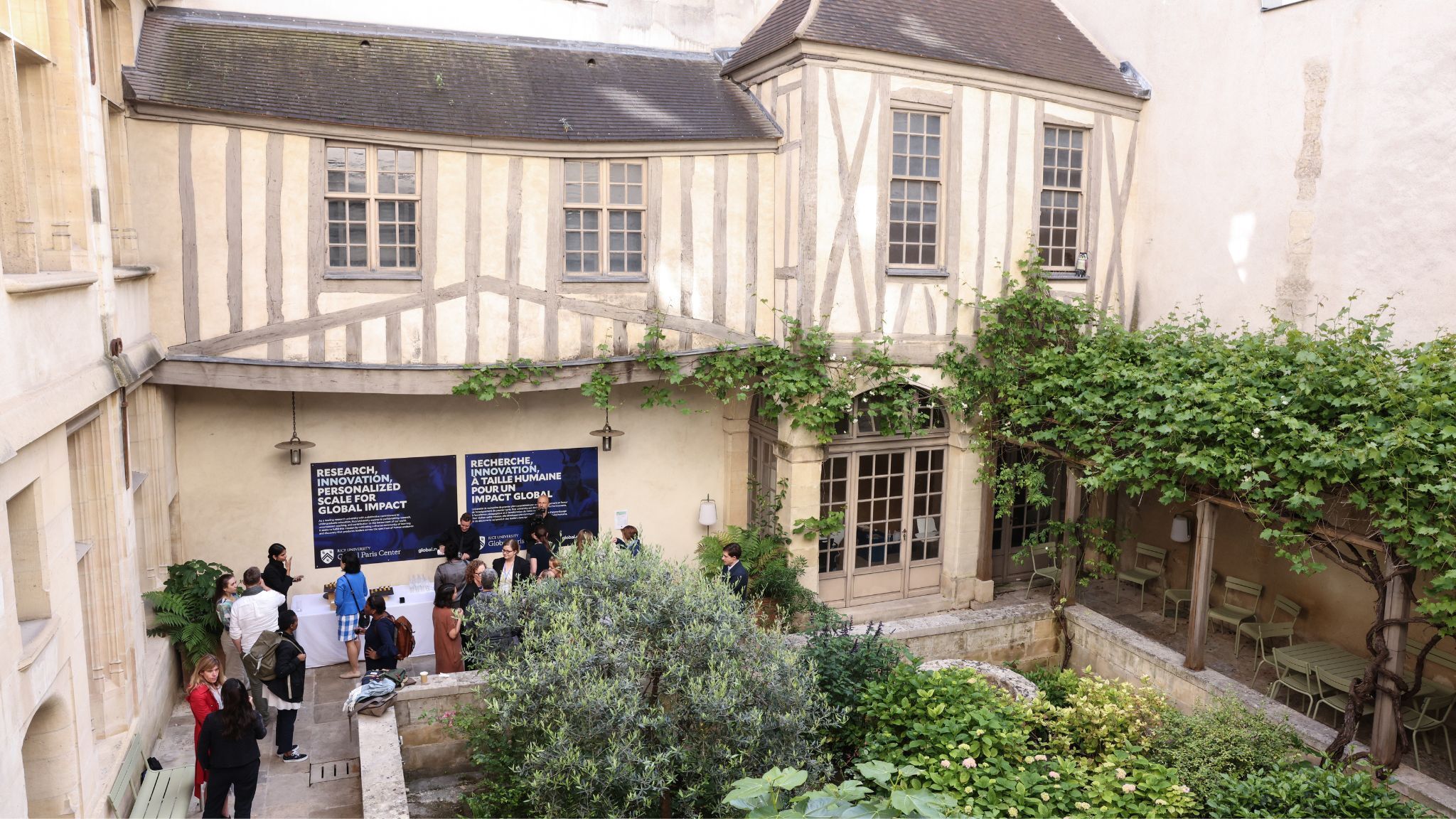
Rice Global Paris Center
The meeting takes place at Rice University's center in the Marais, one of the oldest neighborhoods in Paris. The building dates from 1540 and was built as a private residence in the reign of Francis I. It is set back from the street around a private courtyard and garden, and now hosts research meetings, conferences, and student programs.
The meeting room seats 35, which sets the size of the meeting.
Getting there
- Metro: Hôtel de Ville (lines 1 and 11) or Saint-Paul (line 1), a few minutes' walk.
- From Charles de Gaulle airport: RER B to Châtelet–Les Halles, then metro line 1 or a short walk; about 70 minutes.
- From Orly airport: metro line 14 to Châtelet, then metro line 1 or a short walk.
- From Gare de Lyon: metro line 1, about 15 minutes.
The streets around the center are narrow; public transport or walking is recommended.
Accommodation
Many hotels are within walking distance in the Marais and around Châtelet. July is high season in Paris; we recommend booking early.
Organizing committee
- Pablo Yepes (chair)Rice University
- Anssi KuhaMetropolia University of Applied Sciences
- Travis NorsenSmith College
- Xavier OriolsUniversitat Autònoma de Barcelona
- Jared StensonRice University
Advisory committee
- Jean BricmontUCLouvain (emeritus)
- Dustin LazaroviciTechnion – Israel Institute of Technology
- Avraham MerzelHebrew University of Jerusalem